
Discover Al Araqib
The Resilient Heart of the Negev
Join us in exploring the rich history and enduring spirit of Al Araqib, a village that stands as a symbol of resilience and hope in the face of adversity.
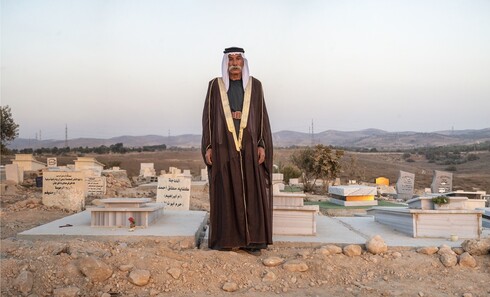
Sheikh Sayah Al-Touri
The Story of Al Araqib
Founded centuries ago, the Bedouin village of Al Araqib has a storied past that reflects the deep-rooted traditions and unyielding spirit of its people. Despite facing numerous demolitions since 2010, the villagers have continually rebuilt their homes, standing firm in their fight for recognition and rights to their ancestral lands. This section delves into the village’s history, from its early days to the ongoing struggle for justice and acknowledgment.
A Legacy of Resilience
Al Araqib’s history is marked by its community’s unwavering determination to preserve their way of life and heritage. The village has become a symbol of the Bedouin struggle in the Negev, highlighting the broader issues faced by Bedouin communities in Israel. Through their perseverance, the villagers of Al Araqib continue to inspire and mobilize support for their cause, hoping to bring about meaningful change and recognition of their rights.

Land ownership
The Bedouin families of Arakib say they own about 4,600 acres of the Negev desert, and that they paid property taxes to the Ottoman Empire and later to the British Mandatory authorities in Palestine. Community leaders say they were forced by Israel’s military into settlements along the border of the West Bank in 1951, and that they have been pushed off their land whenever they have since tried to return.
Israeli officials say the property was taken over by the state in the early 1950s because it was abandoned, and because its inhabitants were unable to produce deeds. They maintained that the Bedouins have been squatters who refused to pay rent; they cultivated land that did not belong to them, and were raising animals without livestock permits. Authorities claim that there has never been a permanent Bedouin settlement in the area. The Ottoman authorities permitted the clan members to graze their sheep and cows on this land, but did not give them ownership over it.
According to the Israel Lands Administration (ILA), Bedouins began illegally settling in the area in 1998, and several dozen families built homes in the area in 1999 when it appeared the government was attempting to seize the land. The ILA offered to rent the land for 2 NIS per dunam, but the inhabitants refused to pay and “continued to infiltrate the land year after year.” In 2000, an Israeli court order banned the Bedouins from entering the area. The ruling was disregarded, as Bedouins continued to move into the area and plant trees. In 2003, the ILA secured a court order to evacuate the residents, and the case went to the Israeli Supreme Court. In 2004, though one resident speaks of crop dusters poisoning the fields in the later 1990s, the Israel Land Administration used crop duster fumigation to destroy the residents’ wheat crops. This practice was outlawed by the court in 2007 after the Adalah legal center for Arab rights in Israel filed a petition to the Israeli Supreme Court on behalf of the residents of Al-Araqeeb and Wadi al-Bakar.
Tens of thousands of structures have been built in Bedouin communities, and new ones are built more quickly than the state can demolish them. They are illegal since the state never issues construction permits for the unrecognized villages.
In July 2011 the state filed a NIS 1.8 million suit against 34 Bedouins from the Abu Mediam and Abu Jabber families, whom they accuse of illegal encroachment on state lands. The suit seeks to reclaim the state costs of evicting families from the Negev village.
The History of Al Araqib
According to a resident of Al-Araqeeb, his ancestors migrated to the region from Yemen and Saudi Arabia. He says the family later bought the land from Bedouin tribes that controlled the area.
After the 1948 Arab–Israeli War, Israel began to displace the Bedouin of the Negev. By 1953, 90% of the roughly 100,000 Bedouin in the northern Negev were expelled. According to Eyal Weizman, the refugees moved to Gaza and the West Bank. The Bedouin from Al-Araqib (“Gentle Hills”), such as the al-Tūris and al-‘Uqbis, have fought to return to their ancestral lands. The village lies on the 200mm RPA (rainfall per annum) drawn by Israeli meteorologists on the basis of a schema developed by Wladimir Köppen to define cultivable land in the desert. Two archives were established to document the local Bedouins rights to their land, one by Nūri al-‘Uqbi and another by Israeli geographer Oren Yiftachel. The At-Turi cemetery of the Al-Araqeeb Bedouin dates to 1914.
Israeli courts have rejected suits to reclaim this land, refusing to acknowledge Bedouin tenure south of the 200 mm line, which is reserved for kibbutzim and moshavim. In 2012 an Israeli court turned down a suit by the al-‘Uqbis to win their title based on a claim of continuous cultivation, recognized by the state.
The Jewish National Fund planned to include the land of Al-Araqeeb in a forestation project in the Negev Desert called Ambassadors’ Forest, honoring the assistance provided to Israel by the world’s diplomatic corps. Some Bedouin living in Rahat and villages nearby objected to the plan. In July 2010 the village was demolished by 1,300 police officers, acting under orders of the Israel Land Administration.
After a six-year-long court case, in a precedent-setting ruling on March 15, 2012, the Beersheba District court ruled against the six lawsuits brought by the Al-Uqbi family, which claimed private ownership of land in the Al-Araqeeb area. Based upon the experts’ testimony and the presented evidence, the judge ruled that the land was state-owned.
Disregarding the ruling, the Bedouin returned 59 times to rebuild the structures, but each time they were razed by the state. Aziz al-Touri, a representative of the village has asked why Jews are permitted to move to the Negev and live in kibbutzim, moshavim and isolated farms while that right is denied the Bedouin desiring to dwell in their own villages. The interviewers comment that the 1948 Palestinian exodus never ended.
The fight for our land
The Bedouin village of al-‘Araqib in the Negev / Naqab desert in southern Israel has been demolished by the Israeli authorities more than 200 times since July 2010.
This is being done to make way for a forest, while nearly 300 Bedouin men, women and children face permanent forced eviction from their homes and land to which they have a long-established claim.
Now they cannot even access the land on which they used to live, grow their crops and keep their livestock, and their olive and fruit trees have been uprooted to enable the planting of the new forest which will not benefit them.
Al-‘Araqib is one of more than 40 “unrecognized villages” in Israel whose residents, all Palestinian citizens of Israel, lack security of tenure and public services. Contrary to statements by the authorities, the residents of al-‘Araqib can document their claims to the land dating back to Ottoman times, but the Israeli government has consistently refused to recognise these claims.
The villagers have initiated legal proceedings seeking recognition of their traditional land claims. However, some of their court appeals are pending even as the Jewish National Fund (JNF) continues with forestation plans over the villagers’ lands.
Israel needs to find long-term solutions to address the irregular situation of al-‘Araqib and the dozens of other unrecognized villages like it. It could start by ending its policy of demolishing these villages and take steps to officially recognise al-‘Araqib and similar villages, at least until there is a resolution to the land claims and a solution which takes into account the needs and human rights.